Showing posts with label v8. Show all posts

Saturday, December 20, 2014

McLaren's Porsche 911 rival...Check it out...


McLaren's P13 Sports Series is edging ever closer to its debut in the second quarter of 2015. 

Part of the Sports Series range, the coupe we spied testing is likely to first appear at the New York Motor Show in April. Spider convertible and track focused versions of the sub-650S model code-named P13 are likely to follow in its footsteps.

McLaren has now confirmed that its latest model, previously referred to only by its internal codename ‘P13’, will be known as the McLaren Sports Series,' it said. 'It will join the range below the 650S, bringing McLaren credentials and exclusivity to the sportscar segment for the first time.’

A detuned version of McLaren’s 3.8-litre twin-turbo V8 with upwards of 450bhp will provide power. The carbon chassis shared with both of its bigger brothers should also make the Sport Series the lightest in its class.

It uses the same carbonfibre MonoCell as the bigger 650S family - and essentially the same 3.8-litre V8, although detuned for its more lowly merely-got-to-beat-a-911-Turbo status.


This is more of a daily driver, and McLaren has consequently made the sills slimmer to ease access, the cabin is roomier and there’s more luggage space too.

The nose has been crafted with the same contoured bonnet, as too have the muscular haunches and gaping door vents. Unlike the P1 and 650S, however, the exhausts have been moved to the lower section of the rear bumper.


Friday, November 21, 2014

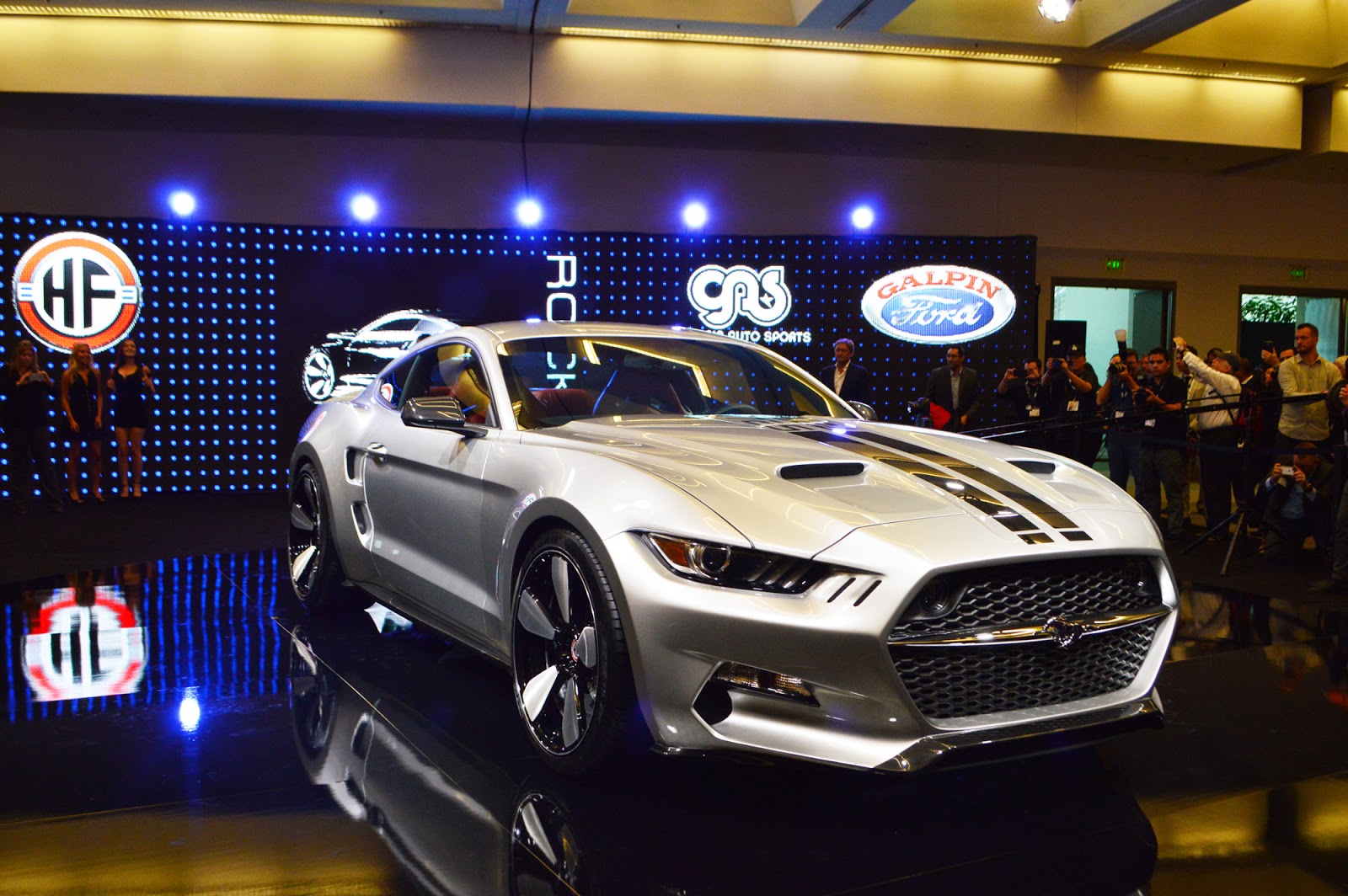
Galpin-Fisker Rocket 2015 Ford Mustang


When renowned designer Henrik Fisker approached his longtime friend and colleague, Galpin Auto Sports manager Beau Boeckmann, with advanced design sketches for a super-tuner 2015 Ford Mustang, the two wasted no time. And in Less than four months, the 725 horsepower Galpin-Fisker 'Rocket' is turning heads at the 2014 Los Angeles auto show. These tw muscle car maniacs are now preparing to put this monster into production.

The Rocket was designed by Henrik Fisker, who has a pretty good track record of designing striking cars. He's worked on the BMW Z8, Aston Martin DB8 and 9, and, of course, the Fisker Karma, which, for all its troubles, was at the very least a remarkable design.


Rocket’s design also builds heavily on the modern lines and cues on the 2015 Ford Mustang GT on which it is based. The familiar Mustang logo gallops across a hexagonal carbon-fiber grille, split horizontally by an aluminum bar. The Galpin-Fisker Rocket’s new face sits on top of a carbon-fiber front splitter, which is matched with enlarged front intakes and two massive hood scoops that help cool the car’s 725-hp V-8 engine. Custom side skirts, flared fenders, brake-cooling side skirts (for the 15-inch Brembos), a rear diffuser, and a rear decklid spoiler are also included to improve aerodynamics and downforce.

“My favorite Mustang is the 1968 Shelby GT500 that had this long hood and huge air intakes,” said Fisker, in a statement. “It gave me butterflies the first time I saw it. We wanted to recreate that feeling with this car.”
As impressive as the car looks in person, what’s even more impressive is the time frame in which it went from idea to reality. Once the ball started rolling on the Rocket, the partners were dead-set on bringing the car to life. “When [Fisker] showed me that design, I literally got chills,” Boeckmann told AUTOMOBILE at the Los Angeles auto show. Galpin Auto Sports would then unveil a one-off tuner 2015 Ford Mustang at SEMA, with the same supercharged, 725-hp V-8 engine.

Tuesday, November 18, 2014

2016 Ford Mustang Shelby GT350


Features :

500 horsepower from Ford's first production flat-plane crankshaft 5.2-liter V8 — an engine usually associated with a European sports cars or race cars.

The 2016 Shelby GT350 has a six speed manual transmission and five different driving modes.

The 2015 Mustang, which is the base of the 2016 Gt350 is already 28% stiffer than the previous car and the GT350 is even stiffer still and the ride height has been lowered by about two inches.

The GT350 gets a new aluminium hood that has been sloped and lowered to look even better.

The aluminum front fenders accommodate the wider front track and wider wheel arches.

The GT350 has some advanced materials and technologies including Ford's first use of MagneRide dampers, a system long used by General Motors for continuous adjustment of the suspension for optimal handling.

To harness all its power, the car has Brembo brakes and the car has stiff 19-inch aluminum-alloy wheels with Michelin Pilot Super Sport tires with customized sidewalls, tread face and compound for maximum grip on the road or at the track.

The car is also more aerodynamic.

The interior was designed around the driver with specially designed Recaro sport seats, a flat-bottom steering wheel and upgraded gauges to monitor performance. Ford even took out a lot of the chrome trim that might otherwise distract the driver.


Sunday, November 16, 2014

Hennessey Venom F5

The Hennessey Venom GT made quite a splash when it set a  Guinness World Record for the fastest production car from 0–300 kilometres per hour (0–186 mph) with an average acceleration time of 13.63 seconds. Also, the car set an unofficial record for 0–200 mph (0–322 km/h) acceleration at 14.51 seconds, beating the Koenigsegg Agera R's time of 17.68 seconds, making it the unofficial fastest accelerating car in the world. 


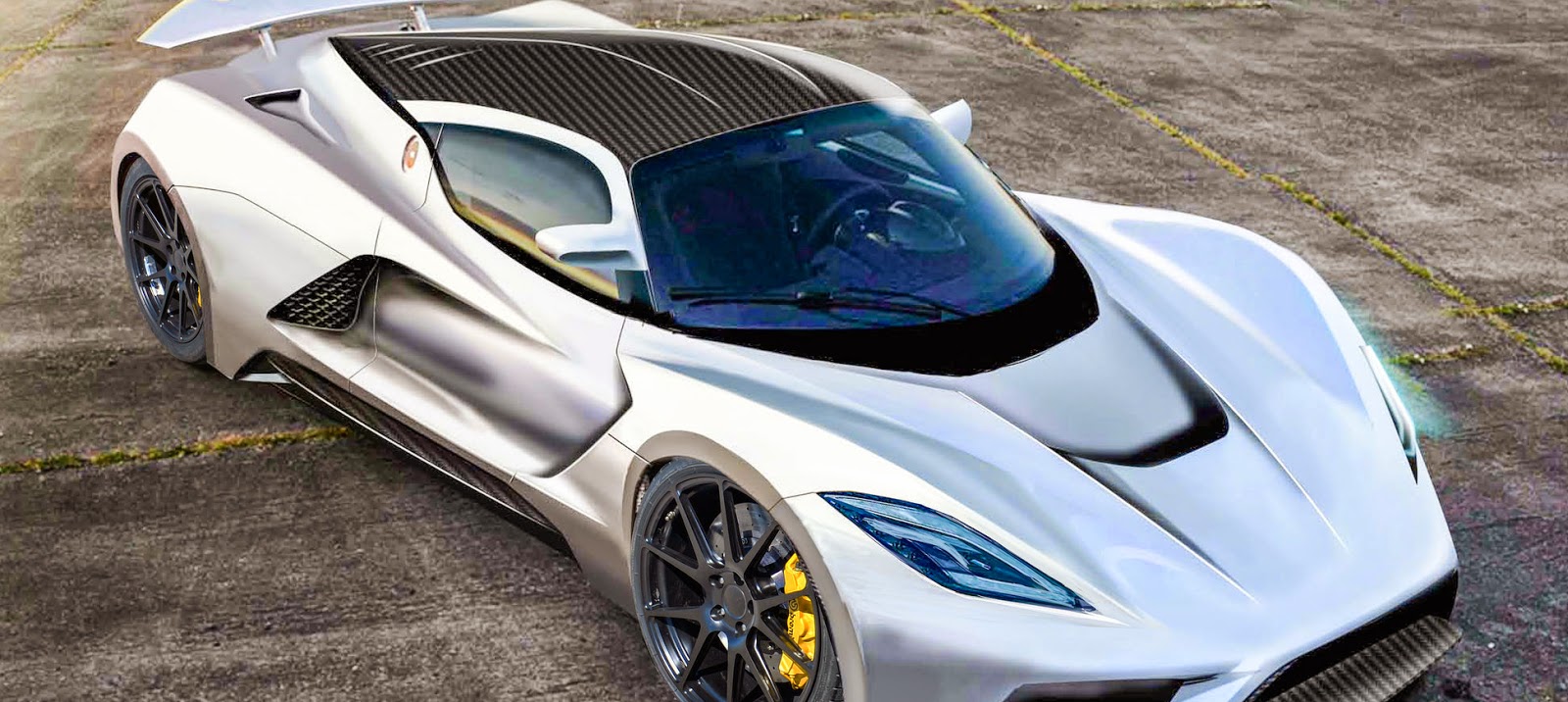
Here is its successor, the Hennessey Venom F5....


Why is it called F5? Here's the answer...The name F5 is derived from a top speed tornado. The Fujita scale pegs the strongest tornado as an F5, with windspeed of about 261 to 318 mph, which is in the region of the speed barrier that the Venom F5 was designed to break. Thus the name F5...


The new supercar from Hennessey Performance, Venom F5, will have 
an all-new design that is not only a powerful and unique but a vehicle that will achieve even higher performance through improved aerodynamics than its predecessor.


The next-generation twin-turbo powertrain is still under development, but turbo size for the longitudinally mounted V8 is increased, and the fuel system and intercooler capacity are upgraded to handle the demands of increased boost. Hard numbers for power are not yet available, but it’s conceivable that output could exceed 1400 bhp.


With extensive use of carbon fiber and aluminum, weight will remain under 1300 kg (2866 lb.), just slightly more than the Venom GT’s 1244-kg curb weight. So it’s highly probable the F5 will eclipse the Venom GT’s current acceleration records too, which stand at 14.51 seconds to 200 mph, and 13.63 seconds to 186 mph (300 km/h).


The Venom F5 will be unveiled in 2015 with deliveries to customers in late 2016. At least 30 Venom F5s will be produced for sale worldwide, at a price higher than that of the Venom GT, which currently sells for $1.2 million. The Venom GT will continue to be offered; at present, 16 cars of the 29-car total production run have been sold.

Monday, November 10, 2014

Ken Block's 1965 Ford Mustang Hoonicorn RTR

Why is the Hooonicorn getting people mad? Here's the reason....


Block's ASD Motorsports and Vaughn Gittin Jr.'s RTR built the Hoonicorn over the course of two years using input from Block’s twisted mind and inspiration from just about every corner of motorsport. Gymkhana 7 should be the best thing ever.


  • The 1965 Ford Mustang packs a 410 cubic-inch Roush Yates Ford V8 engine used in NASCAR, good enough to produce 845 horsepower. 
  • It is an AWD (All Wheel Drive) and a six-speed manual gearbox dumps power to the pavement.
  • The wide Mustang body is the work of RTR and Block’s own Hoonigan Racing Division, while the 18-inch fifteen52 wheels are shod in Pirelli Trofeo R tires that use a specialized compound exclusive to Block.
  • Block has basically married a NASCAR stock car with a WRC racer.


*information taken from autoblog