Showing posts with label performance car. Show all posts

Wednesday, December 3, 2014

Reiter Engineering's Lamborghini Gallardo FL2 GT3


The REITER Gallardo Strada GT3 is a derivate of the famous REITER Gallardo GT3 race car which has won and participated in countless GT3 races all over the world in Europe, Asia, Australia and America. 

The engine has racing camshafts for an improved torque curve, while new MAHLE pistons make it less thirsty while improving reliability.

The GT3 gets a carbon fibre front bumper with integrated louvers. Wider carbon fiber front fenders complement the race-like front optic which have been carried over from the race car.

The rear end is wider, with a 13cm increase to the rear axle width, which will helps better handling. The rear wing is a carry over part from the REITER Gallardo GT3 race car. The aluminium rear side panels have been replaced with carbon-fibre panels. The headlights as well as rear lights have been replaced with new ones.

The GT3 has an all black comfortable race-like interior design . FIA fire extinguisher system in carbon fiber look which has a concealed extinguisher fire button.

Some other performance upgrades are:
  • Stainless steel muffler system manufactured by our partner and Formula 1 supplier MHG
  • Weight reduction ca. 9 kg
  • Increased power output (10 hp gain)
  • Adjustable exhaust sound by using remote control

Thursday, November 27, 2014

2015 Chevrolet Corvette Z06

2015 Chevrolet Corvette Z06

Specs:

Vehicle Type: front-engine, rear-wheel-drive, 2-passenger, 3-door

Engine Type: supercharged and intercooled V-8, aluminum block and heads, direct fuel injection

Displacement: 376 cu in, 6162 cc

Power: 650 hp @ 6400 rpm

Torque: 650 lb-ft @ 3600 rpm

Transmission: 8-speed automatic with manual shifting mode


Dimensions & Weight

Wheelbase: 106.7 in

Length: 176.9 in

Width: 77.1 in 

Height: 48.6 in

Curb weight: 3558 lb


Performance:

Zero to 60 mph: 3.0 sec

Zero to 100 mph: 6.8 sec

Zero to 160 mph: 22.9 sec

Saturday, November 22, 2014

2016 Mazda MX-5 Miata Cup Race Car


The MX-5 Miata Cup Race car, will compete in a new global single-make Miata racing series.

Mazda hasn't  yet revealed the car's final specifications, but  performance enhancing upgrades to the exhaust, suspension, intake, and brakes to today's Miata look likely.

The MX-5 Miata Cup car will use a 2.0-litre four cylinder engine which will be locked to prevent any internal tampering and a six speed manual transmission. It is expected to weigh about the same as the roadgoing Miata around 2300 pounds.

The MX-5 Cup Race Car will cost less than $50,000 with all the upgrades so that the owners won't have to spend more time and money to add the performance kits.

The car will be fitted with a full roll cage and fire-suppression system.

A passenger seat will be optional while air condtioning will not be available. A roof and windows arent included.

Final power figures and exact specs for the 2016 MX-5 Miata Cup car will be out soon.


Friday, November 21, 2014

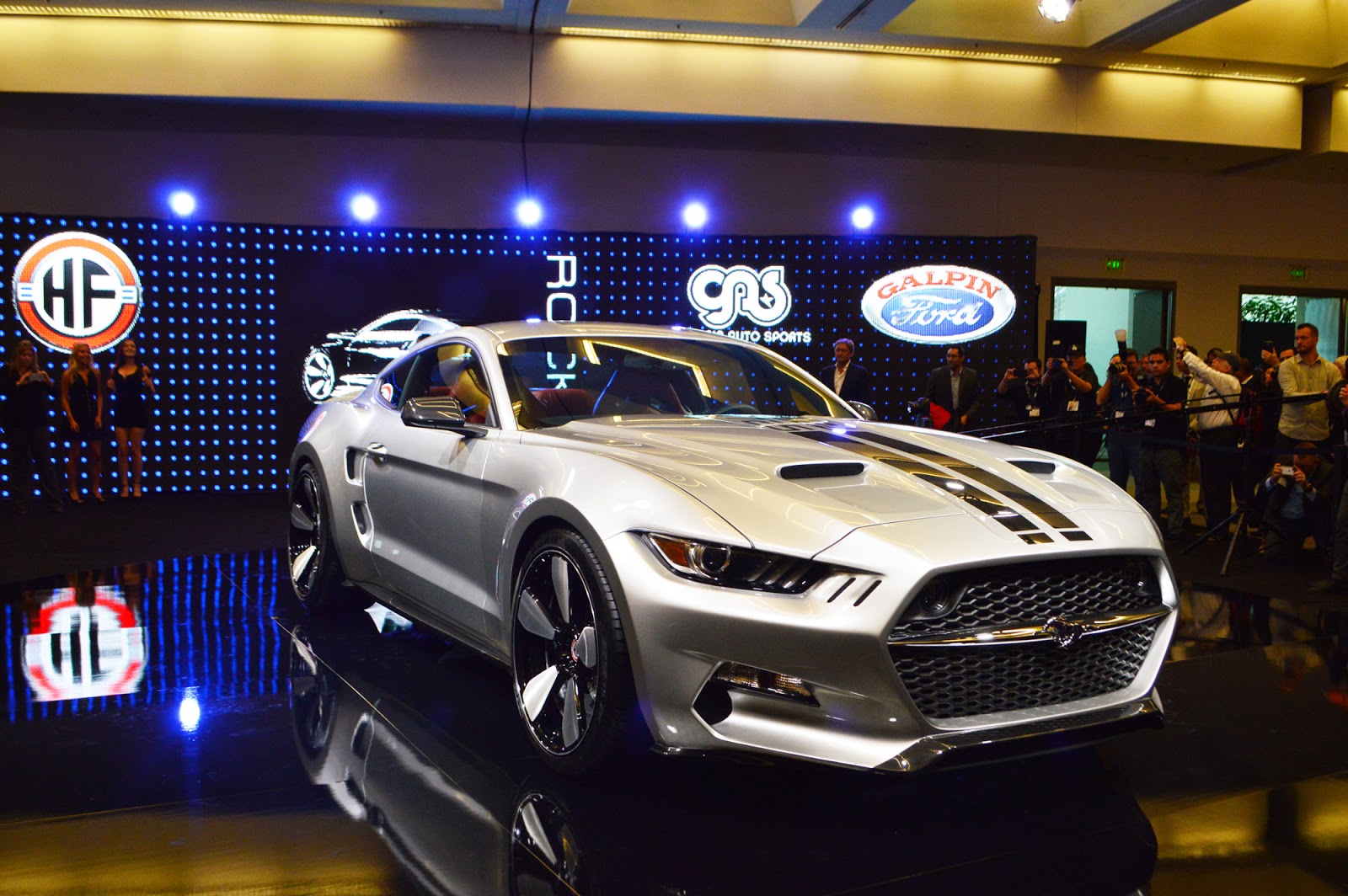
Galpin-Fisker Rocket 2015 Ford Mustang


When renowned designer Henrik Fisker approached his longtime friend and colleague, Galpin Auto Sports manager Beau Boeckmann, with advanced design sketches for a super-tuner 2015 Ford Mustang, the two wasted no time. And in Less than four months, the 725 horsepower Galpin-Fisker 'Rocket' is turning heads at the 2014 Los Angeles auto show. These tw muscle car maniacs are now preparing to put this monster into production.

The Rocket was designed by Henrik Fisker, who has a pretty good track record of designing striking cars. He's worked on the BMW Z8, Aston Martin DB8 and 9, and, of course, the Fisker Karma, which, for all its troubles, was at the very least a remarkable design.


Rocket’s design also builds heavily on the modern lines and cues on the 2015 Ford Mustang GT on which it is based. The familiar Mustang logo gallops across a hexagonal carbon-fiber grille, split horizontally by an aluminum bar. The Galpin-Fisker Rocket’s new face sits on top of a carbon-fiber front splitter, which is matched with enlarged front intakes and two massive hood scoops that help cool the car’s 725-hp V-8 engine. Custom side skirts, flared fenders, brake-cooling side skirts (for the 15-inch Brembos), a rear diffuser, and a rear decklid spoiler are also included to improve aerodynamics and downforce.

“My favorite Mustang is the 1968 Shelby GT500 that had this long hood and huge air intakes,” said Fisker, in a statement. “It gave me butterflies the first time I saw it. We wanted to recreate that feeling with this car.”
As impressive as the car looks in person, what’s even more impressive is the time frame in which it went from idea to reality. Once the ball started rolling on the Rocket, the partners were dead-set on bringing the car to life. “When [Fisker] showed me that design, I literally got chills,” Boeckmann told AUTOMOBILE at the Los Angeles auto show. Galpin Auto Sports would then unveil a one-off tuner 2015 Ford Mustang at SEMA, with the same supercharged, 725-hp V-8 engine.

Sunday, November 16, 2014

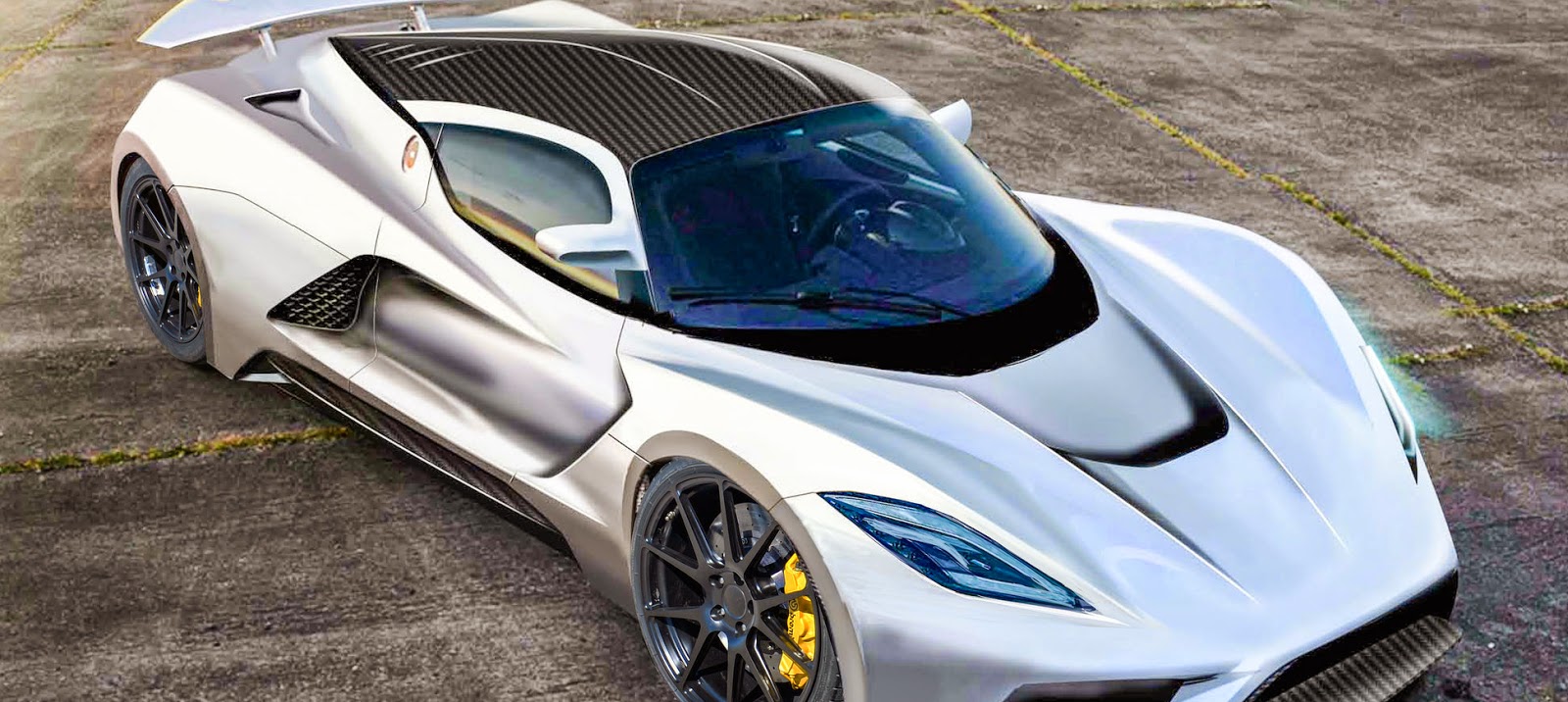
Hennessey Venom F5

The Hennessey Venom GT made quite a splash when it set a  Guinness World Record for the fastest production car from 0–300 kilometres per hour (0–186 mph) with an average acceleration time of 13.63 seconds. Also, the car set an unofficial record for 0–200 mph (0–322 km/h) acceleration at 14.51 seconds, beating the Koenigsegg Agera R's time of 17.68 seconds, making it the unofficial fastest accelerating car in the world. 


Here is its successor, the Hennessey Venom F5....


Why is it called F5? Here's the answer...The name F5 is derived from a top speed tornado. The Fujita scale pegs the strongest tornado as an F5, with windspeed of about 261 to 318 mph, which is in the region of the speed barrier that the Venom F5 was designed to break. Thus the name F5...


The new supercar from Hennessey Performance, Venom F5, will have 
an all-new design that is not only a powerful and unique but a vehicle that will achieve even higher performance through improved aerodynamics than its predecessor.


The next-generation twin-turbo powertrain is still under development, but turbo size for the longitudinally mounted V8 is increased, and the fuel system and intercooler capacity are upgraded to handle the demands of increased boost. Hard numbers for power are not yet available, but it’s conceivable that output could exceed 1400 bhp.


With extensive use of carbon fiber and aluminum, weight will remain under 1300 kg (2866 lb.), just slightly more than the Venom GT’s 1244-kg curb weight. So it’s highly probable the F5 will eclipse the Venom GT’s current acceleration records too, which stand at 14.51 seconds to 200 mph, and 13.63 seconds to 186 mph (300 km/h).


The Venom F5 will be unveiled in 2015 with deliveries to customers in late 2016. At least 30 Venom F5s will be produced for sale worldwide, at a price higher than that of the Venom GT, which currently sells for $1.2 million. The Venom GT will continue to be offered; at present, 16 cars of the 29-car total production run have been sold.

Saturday, November 15, 2014

VW will bring the 2015 Golf R 400 Concept to the L.A. Auto Show

Volkswagen unveiled the Golf R 400 Concept at the Beijing auto show earlier this year. And from news, it is clear that Volkswagen are bringing their famous hatch to the Los Angeles Auto Show.


To refresh the new version of the legendary car, the R 400 features a Haldex 5 AWD system  and a turbo-boosted 2.0-litre engine. The standard Golf R makes a healthy 292 horsepower. The extra hundred ponies on the R 400 are able to push the German icon to 60 mph in under four seconds.

VW claims 3.9 seconds, which puts it on terms with a 2014 Corvette Stingray. The Vette makes more power than the R 400, but the Golf uses all four wheels to move the much lesser weighted body.

The gearbox is a seven-speed DSG , the interior is laced with carbon, and two center-exit pipes protrude from the rear. In terms of looks, the Golf R 400 is aces, resplendent in silver with lemon-yellow accents.


Wednesday, November 12, 2014

2015 Ford Mustang GT “King Cobra”

SEMA 2014 saw a handful of Mustang put up on show. Believe me, after checking out the pictures of all of them has really made me fall deeper in love with the American muscle car. The RTR Spec 5 Concept and then the 1965 Hoonicorn Mustang blew people away at tyhe SEMA Auto Show 2014.


Ford Racing just showed off exactly how crazy you can get with the newest pony, throwing its entire catalog of factory-supported go-fast high performance parts at our favourite coupe. The result is the King Cobra, a 600-plus-horsepower supercharged Stang that can rip through the quarter-mile at a staggering 10.97 seconds.


Ford Racing has made its intentions clear to make a fast car go even faster as it has put all of its Ford Racing kits and upgrades into the King Cobra.


The King Cobra has a 2.3-litre belt-driven supercharger developed in conjunction with Roush Performance,  along with the requisite intake manifold, throttle body, air intake, air-to-liquid intercooler, fuel rail with high-flow injectors, and retuned ECU.


Also the King Cobra prototype 2015 Mustang reportedly blasted down Michigan’s Milan Dragway to a 10.97 second quarter-mile on slicks.


Tuesday, November 11, 2014

2014 KTM X-Bow GT Specifications

KTM X-Bow GT Specifications


Dimensions & Weight:

Length x Width x Height
3,738 x 1,915 x 1,202 mm (147.1 x 75.4 x 47.3inches)
Wheelbase
2,430 mm (95.6 inches)
Turning radius
10.8 m (35.4 feet)
Height of centre of gravity
390 mm (15.35 inches)
Fuel tank capacity
40 l (10.56 gallons)
Weight excl. fuel
847 kg (1,867 pounds)
Aerodynamic down-force @ 100 km/h (62 mph)
25 kg (55.11 pounds)
Aerodynamic down-force @ 200 km/h (124 mph)
100 kg (220 pounds)
Static weight distribution (front / rear)
38:62


Performance & Driveline:
Displacement
1,984 cc
Performance
210 kW (281 horsepower) @ 6,400 rpm
Maximum torque
420 Nm (309 pound-feet) @ 3,200 rpm
Fuel consumption
8.3 l/100 km (28.33 mpg)
CO₂-emission
189 g/km